
Most small businesses aren’t falling short because they don’t care about security. They are falling short because they didn’t build their security strategy as one coordinated system. Instead, they added tools over time to solve immediate problems: a new threat here, a client request there, or a flashy software demo somewhere else.
On paper, that can look like strong coverage. In reality, it often creates a patchwork of products that do not fully work together. Some areas overlap and waste your budget. Other critical gaps get overlooked entirely. When security isn’t intentionally designed as a system, the weaknesses do not show up during routine support tickets. They show up when something slips through and turns into a disruptive, expensive disaster.
At Leap Forward Tech, we see this “Patchwork Monster” often. Our goal is to move you from a reactive posture to a proactive baseline that protects your livelihood without making your daily work life a headache.
Why Layers Matter More in 2026
In 2026, your small business security cannot rely on a single control that is “mostly on.” It must be layered because attackers do not politely line up at your firewall anymore. They come in through whichever gap is easiest today.
The real story is how quickly the landscape is changing due to two major factors.
1. The AI Factor
The World Economic Forum’s Global Cybersecurity Outlook 2026 notes that AI is the most significant driver of change in cybersecurity. This is more than just a headline. It means phishing emails are now indistinguishable from real ones. Automation has become affordable for criminals. “Spray and pray” attacks are now targeted and effective at a massive scale. If your security model depends on one or two layers catching everything, you are essentially betting against the house.
2. Active Enforcement Standards
The NordLayer MSP trends report highlights that simply checking a compliance box is no longer enough. The market is shifting toward consistent security baselines and proactive oversight. Regular cyber risk assessments are becoming a necessity to find gaps before an attacker does.
The easiest way to keep layers practical is to think in outcomes, not tools.
How to Spot Gaps in Your Cybersecurity

The easiest way to spot gaps in your security is to stop thinking in products and start thinking in outcomes. A practical way to structure this is the NIST Cybersecurity Framework 2.0. It groups security into six core areas.
- Govern: Who owns the decisions? What are your standards?
- Identify: Do you actually know every device and account you are protecting?
- Protect: What is in place to reduce the chance of a successful attack?
- Detect: How quickly can you recognize that something is wrong?
- Respond: What happens next? Who acts, and how fast is the communication?
- Recover: How do you get back to work and prove everything is normal?
Most small business stacks are strong in Protect. Many are okay in Identify. The missing layers almost always live in Govern, Detect, Respond, and Recover.
The 5 Security Layers Most Businesses Miss
Strengthen these five areas, and your business’s security becomes more consistent, more defensible, and far less reliant on luck.
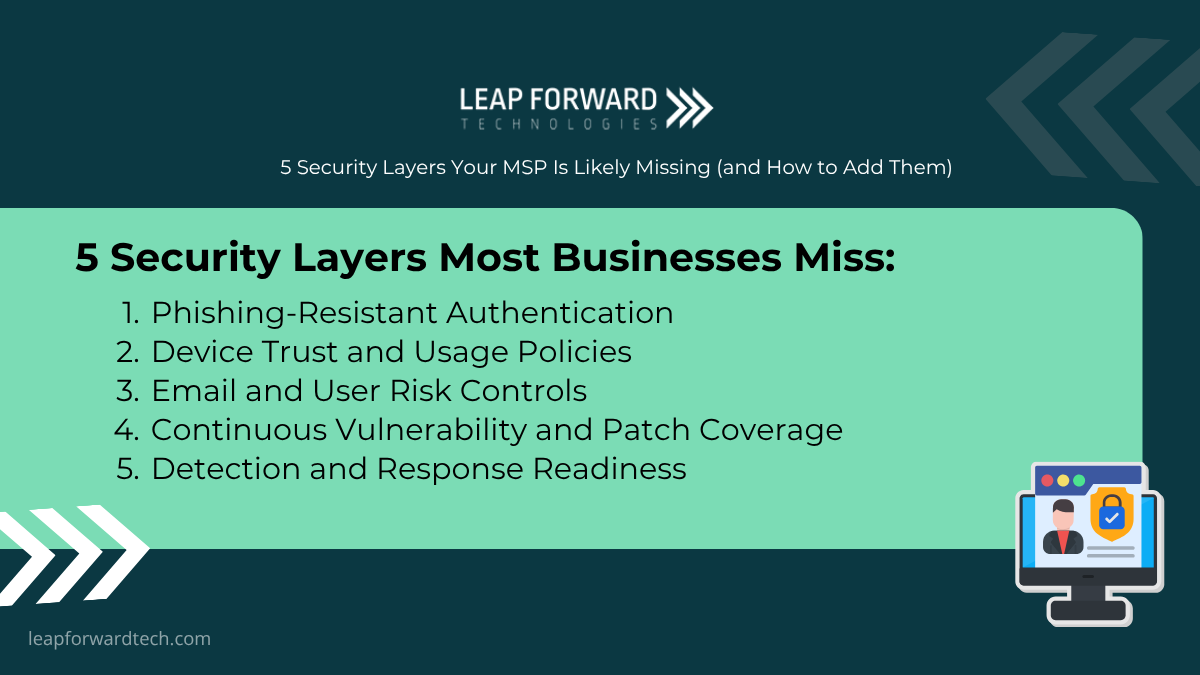
1. Phishing-Resistant Authentication
Basic multifactor authentication (MFA) is a good start, but it is not the finish line. Modern attackers can bypass standard SMS or push-notification MFA.
- The Fix: Make strong, phishing-resistant authentication mandatory for every account. Remove easy bypass options and use risk-based rules that require extra verification for unusual sign-ins.
2. Device Trust and Usage Policies
Most IT systems manage devices, but few have a clearly defined standard for what qualifies as a “trusted” device.
- The Fix: Set a minimum device baseline. Put Bring Your Own Device (BYOD) boundaries in writing. Block or limit access when devices fall out of compliance instead of just sending reminders.
3. Email and User Risk Controls
Email is still the front door for most attacks. If you rely on user training alone, you are betting on your team having perfect attention 100% of the time.
- The Fix: Implement built-in safety rails. Use controls that flag risky senders, block lookalike domains, and label external emails clearly. Make reporting suspicious mail easy and judgment-free.
4. Continuous Vulnerability and Patch Coverage
“Patching is managed” often just means “patching is attempted.” The real gap is proof. You need clear visibility into what failed and which exceptions are quietly piling up.
- The Fix: Set strict patch timelines by severity. Cover third-party apps and hardware firmware, not just your Windows or Mac operating system. Keep an exceptions register so temporary bypasses do not become permanent holes.
5. Detection and Response Readiness
Most environments generate alerts, but many lack a repeatable process for turning those alerts into action.
- The Fix: Define your minimum monitoring baseline. Create simple, practical “runbooks” for common scenarios like a lost laptop or a compromised password. Most importantly, test your recovery procedures in real-world conditions.
Review Your 2026 Cybersecurity Strategy
When you strengthen these five layers, you turn your security into a repeatable, measurable baseline. Start with the weakest layer in your environment. Standardize it. Validate that it is working. Then move to the next.
If you would like help identifying your gaps and building a more consistent roadmap, reach out to us. We will help you assess your current stack and prioritize improvements that strengthen protection without adding unnecessary complexity for businesses across West Central & Southwest Minnesota.
Ready to build a system that actually works?
[Contact Leap Forward Tech for a Security Strategy Consultation]
More from the Blog
Who Can See What Your AI Note-Taker Records?And Why Business Owners Should Care
You start a Zoom, Microsoft Teams, or Google Meet call. A few seconds later, an automated assistant with a friendly…
What Are Passkeys, and Should Your Business Use Them?
Every morning, the same silent tax is collected across your company. It’s the 69 seconds an employee spends resetting a…
How to Prepare Microsoft 365 Permissions for a Safe Copilot Rollout
Enabling Microsoft 365 Copilot without auditing your data permissions is the digital equivalent of inviting a hyper-efficient investigative journalist to…