
It usually starts with a small win. Someone on your team uses an AI tool to polish a difficult email to a client. Another team member enables an AI add-on inside a project management app because it promises to save three hours a week. Someone else pastes a complex contract paragraph into a chatbot to “make it sound more human.”
Then, it becomes a routine.
Once AI usage becomes routine without oversight, it stops being a simple productivity win. It becomes a major data governance issue. You are left wondering what is being shared, where that information is going, and whether you could prove what happened if a breach occurred.
That is the core of Shadow AI. The goal is not to block innovation or pull the plug on AI. The goal is to prevent sensitive business data from being exposed while your team tries to work faster.
What is Shadow AI Security in 2026?
Shadow AI is the unsanctioned use of artificial intelligence tools without IT approval. It is almost always driven by speed and convenience rather than malice. However, the “helpful shortcut” quickly becomes a blind spot when your leadership cannot see what tools are being used, who is using them, or what data is being fed into them.
In 2026, this matters more than ever because AI is no longer just a standalone website you visit. It is embedded directly into the browsers and applications you already rely on. It expands through hidden plugins and third party “copilots” that can tap into your business data with almost zero friction.
The human reality is staggering. Recent data suggests that 38% of employees admit to sharing sensitive work information with AI tools without permission. These are people simply trying to do their jobs better, but they are making risky decisions that could lead to a catastrophic data leak.
Security experts, including those at Microsoft, now view this primarily as a data leakage problem rather than a productivity problem. The risk is not just about which tool was used. The risk is “purpose creep,” which is when your data begins to be used in ways that no longer align with your original privacy agreements or client disclosures.

Two Ways Shadow AI Strategies Fail
Success requires moving beyond “hoping for the best.” Most businesses fail in one of two areas:
1. The Visibility Gap
Shadow AI is often a browser extension or a feature that only shows up for certain users. This means AI usage spreads without a clear moment where a manager would normally review it. If you cannot reliably discover where AI is being used, you cannot apply controls to prevent data leakage.
2. The Management Gap
Even when you can name the tools, security fails if you cannot enforce consistent behavior. This happens when AI activity lives outside your managed identity systems. You end up with “known unknowns.” You assume people are using AI, but you cannot document it, standardize it, or rein it in.
How to Conduct a Practical Shadow AI Audit
A shadow AI audit should feel like routine maintenance, not a crackdown. The goal is to gain clarity, reduce risk, and keep your team moving.
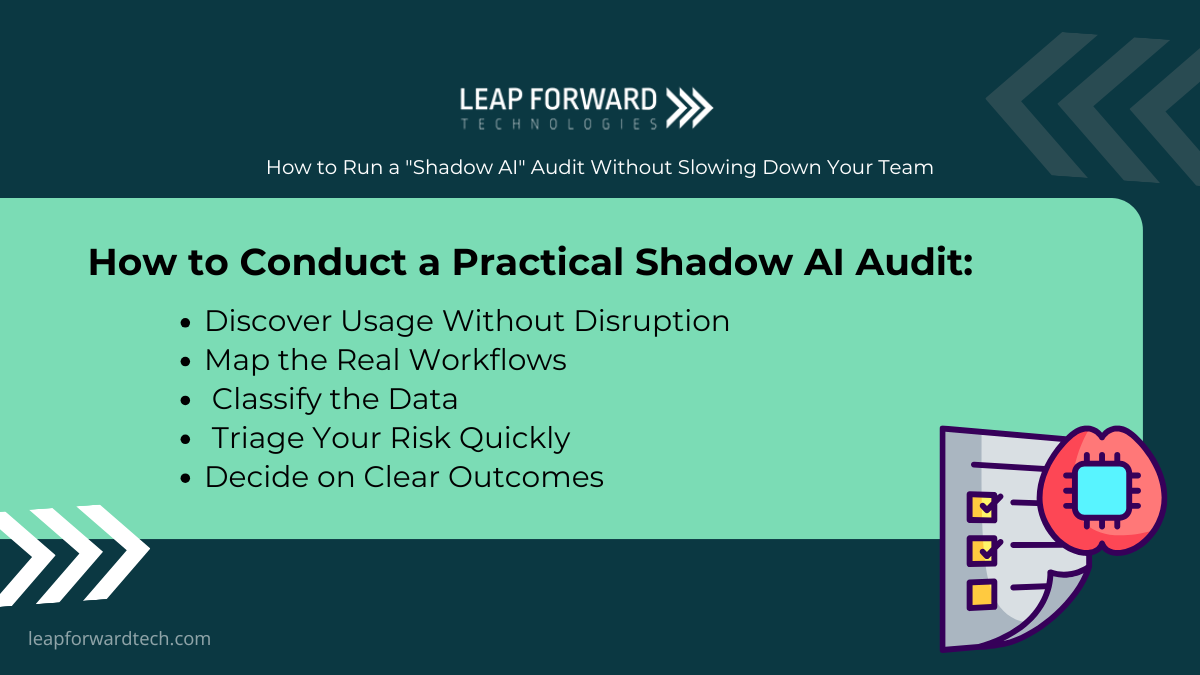
Step 1: Discover Usage Without Disruption
Before sending a company wide warning, review the signals you already have. Look at identity logs to see who is signing into unmanaged accounts. Check your SaaS admin settings for newly enabled AI features.
When you do talk to the team, keep it nonjudgmental. Ask: “Which AI features are actually helping you save time right now?” You will get better answers when you approach this as a way to support them safely.
Step 2: Map the Real Workflows
Do not get obsessed with the names of the apps. Instead, map where the AI touches the work. Build a simple list that tracks the workflow, the AI touchpoint, and what kind of data is being input versus what is being output.
Step 3: Classify the Data
This is where the audit becomes practical. Use simple buckets your team understands:
- Public: Information already on your website.
- Internal: Team memos and non-sensitive notes.
- Confidential: Client files and proprietary strategies.
- Regulated: Financial or health data that requires strict compliance.
Step 4: Triage Your Risk Quickly
Do not try to build a perfect inventory. Focus on the highest risks right now. A simple way to score this is to look at the sensitivity of the data and whether the employee is using a personal account or a managed business account. If the tool does not offer audit logging, it is a high risk.
Step 5: Decide on Clear Outcomes
Make decisions that are easy to follow:
- Approved: Permitted for specific use cases with managed accounts.
- Restricted: Allowed only for low-risk, non-sensitive tasks.
- Replaced: Move the team to an approved, secure alternative.
- Blocked: The risk is too high and there are no workable controls.
Stop Guessing and Start Governing
Shadow AI security is not about shutting down innovation. It is about making sure your sensitive data does not flow into tools you cannot monitor or defend.
A structured audit gives you a repeatable process to identify usage, define data boundaries, and make decisions that stick. Do it once, and you reduce risk immediately. Make it a quarterly discipline, and AI stops being a surprise.
At Leap Forward Tech, we help businesses gain visibility into their digital environments without slowing down their momentum. If you want to put guardrails in place that actually work for your team in West Central & Southwest Minnesota, we are here to help.
Contact Leap Forward Tech to Schedule a Shadow AI Discovery Session