
You open your upcoming cyber insurance renewal application, and it looks less like a standard form and more like a final exam for a master’s degree in cybersecurity. It is longer, hyper-specific, and completely unforgiving.
If you feel like the goalposts have moved, you are right. Insurance carriers spent the last few years paying out massive, headline-grabbing claims. Now, they are writing applications that protect their own bottom lines. Every new question on that form maps directly to a security loophole that allowed a major breach to spiral out of control.
How you answer these questions matters more than ever. Guessing or overstating your security controls to secure a lower premium can lead to rescission a scenario where a future claim is denied because the carrier discovers your actual environment didn’t match your paperwork.
Here is a look at why these applications changed, how to decode the toughest questions, and a 30-day plan to get your systems renewal-ready.
Why Underwriters Stopped Playing Nice
The current generation of cyber insurance applications was shaped by high-profile breach events that redefined industry risk. Underwriters realized that basic defenses were no longer cutting it.
- The Supply-Chain Nightmare (MOVEit): When the Cl0p ransomware group exploited a vulnerability in Progress Software’s MOVEit Transfer tool, it ultimately impacted over 2,650 organizations and tens of millions of individuals. Because carriers paid out claims across an massive global footprint, they now grill applicants about third-party software and vendor data risks.
- The Identity Crisis (Change Healthcare): This massive ransomware incident froze US healthcare claims processing for weeks. The initial entry point? A critical system that lacked multifactor authentication (MFA). With losses scaling into hundreds of millions of dollars, carriers responded by mandating airtight identity controls and immutable backups.
- The Deepfake Deception (Arup): A finance employee transferred $25.6 million after a video call with AI-generated deepfakes of the company’s CFO and executives. This single event shifted social engineering from a simple phishing conversation to an advanced identity verification problem. Out-of-band callback verification is now standard on every underwriter’s checklist.
If your business handles cardholder data, Protected Health Information (PHI), client trust accounts, or escrow funds, your application will be the most demanding. You sit squarely in the categories where carriers have historically lost the most money.
The Shifting Requirements: What Carriers Look For
1. The Death of the Simple Backup Question
What used to be a single yes/no checkbox now requires granular technical details. Carriers no longer just want to know if you have backups; they want to know if an attacker can destroy them.
Typical Exam Question: “Are backups stored in an immutable or air-gapped state, tested for restoration within the past 12 months, and inaccessible using domain administrator credentials?”
An immutable backup cannot be deleted or altered during a fixed retention window, even by someone holding stolen admin credentials. Air-gapped means the backup infrastructure is completely isolated from your production network.
Relying solely on basic cloud storage or default native retention settings is no longer a passing answer. If your third-party backups share the same identity perimeter as your main corporate accounts, a compromised global admin account can wipe out your active data and your insurance safety net simultaneously.
2. MFA Must Be Everywhere (No Exceptions)
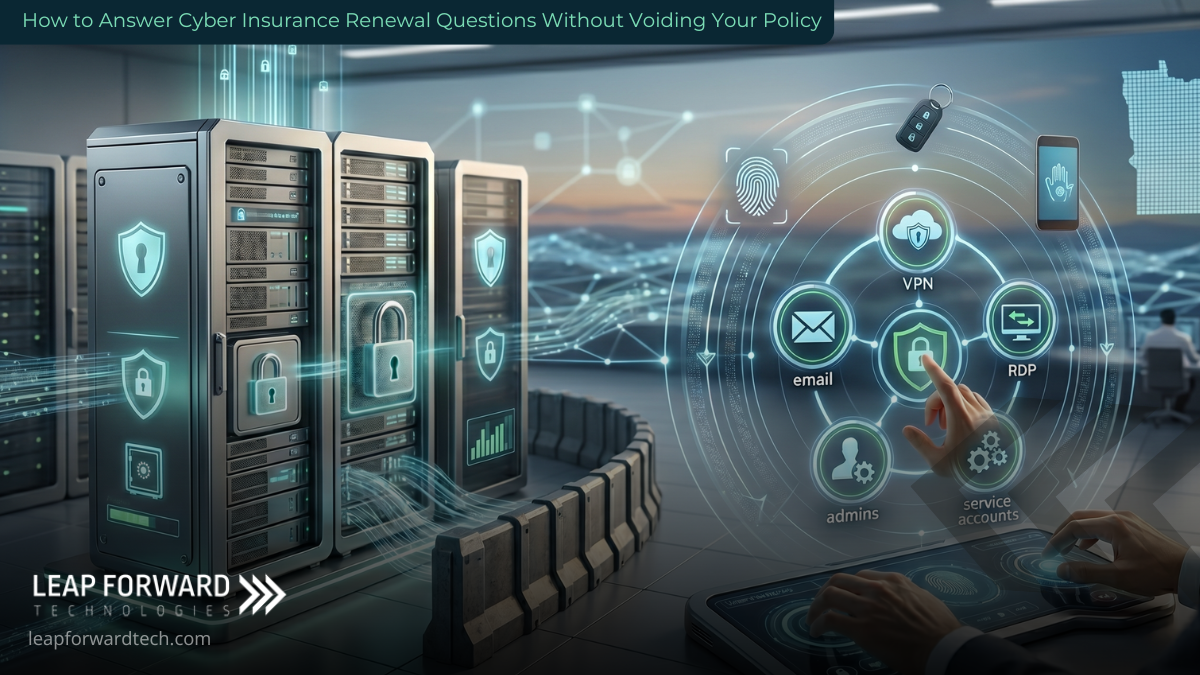
Checking “yes” to MFA on a single corporate email account is no longer enough. To secure a clean approval, MFA must be enforced across five distinct zones:
- Email access
- Virtual Private Networks (VPNs) and firewalls
- Remote Desktop Protocol (RDP) and internal remote access
- All administrator accounts
- Privileged service accounts
Furthermore, SMS-based text codes are increasingly treated as a failed control due to the rise of SIM-swapping attacks. Carriers look for authenticator apps, hardware tokens, or push notifications with number matching.
3. EDR vs. MDR: Traditional Antivirus is Dead
Traditional antivirus programs look for known bad files. Modern threats use legitimate system tools to execute “fileless” attacks. Insurance applications now look for advanced endpoint tracking.
| Security Layer | What It Does | Who Is Watching? | Insurance Status |
| Traditional Antivirus | Scans files against a static list of known malware signatures. | No one active; relies on software alerts. | Failing. Generally insufficient for standalone coverage. |
| Endpoint Detection & Response (EDR) | Monitors device behavior in real-time to flag anomalous activity. | Your internal team or IT point person. | Baseline. Expected for core infrastructure. |
| Managed Detection & Response (MDR) | Combines EDR software with a proactive Security Operations Center (SOC). | A 24/7/365 team of live security analysts. | Preferred. Triggers the best rates and lowest retention limits. |
4. Wire Transfers and Deepfake Verification
Because of business email compromise (BEC) and AI voice cloning, carriers expect a formal verification process before any funds leave your organization.
Expect to confirm whether your business requires out-of-band verification calling a recipient at a previously verified, independently stored phone number for any transfer above a set threshold (typically $10,000 or $25,000). If your team relies on email confirmations alone to approve wire changes, underwriters may decline the social engineering portion of your coverage entirely.
The Ultimate Insurance Trapdoor: Rescission
The single most expensive mistake you can make on a cyber renewal application is overstating your security controls to secure a policy.
Cyber insurance applications function as warranty documents. If you experience a breach and the subsequent forensic investigation reveals that a declared control (like MFA or immutable backups) was missing or improperly configured at the time of the incident, the carrier can rescind the policy.
[ Application Submitted with Inaccuracies ]
                   │
                   ▼
           [ Cyber Incident ]
                   │
                   ▼
     [ Forensic Investigation ]
                   │
                   ▼
 [ Misrepresentation Discovered ] ──► [ Policy Rescinded / Claim Denied ]
Rescission means the policy is treated as though it never existed. Your claim is denied, you absorb the full remediation cost, and any prior payouts during that policy term can be clawed back.
The best path is radical transparency. If you have a security gap, mark “No” or “In Progress” and provide a clear, documented remediation timeline. Carriers look favorably on organizations that acknowledge their gaps and present a concrete plan to fix them.
The 30-Day Pre-Renewal Action Plan
If your renewal is a month away, use this week-by-week checklist to align your environment with underwriter expectations.
Week 1: Identity & Authentication
- Audit MFA placement across all systems. Ensure it is active for all administrators, remote access points, and email tenants.
- Migrate administrative accounts away from SMS authentication to authenticator apps or hardware keys.
Week 2: Backups & Wire Policies
- Confirm your backup platform utilizes object lock or true immutability with a retention window of at least 14 days (30 days preferred).
- Run a live test restore of a critical server, document the successful completion, and save the log file.
- Draft a simple, one-page wire transfer policy mandating out-of-band voice verification for any payment change over your established corporate threshold. Have all authorized signers sign it.
Week 3: Endpoints & Vendor Risk
- Verify that your EDR or MDR agent is deployed across 100% of your endpoints, including virtual environments and legacy servers.
- Identify your top five third-party software vendors who handle sensitive customer or operational data. Request a copy of their latest SOC 2 Type II report for your records.
Week 4: Response Prep & Submission
- Locate your written Incident Response Plan (IRP). Gather your leadership team for a brief, 60-minute tabletop exercise simulating a ransomware event. Document the attendees and notes as evidence of an annual test.
- Complete the application form. Note any unresolved gaps honestly alongside your planned completion dates.
Frequently Asked Questions
What does policy rescission actually mean?
Rescission is a legal remedy where a carrier voids a policy from its inception due to material misrepresentation on the application. The policy is treated as null and void, current claims are rejected, and previous payouts can be clawed back by the insurer.
Will our coverage be denied outright if we lack MFA on everything?
Not necessarily, but it will cost you. Failing to secure key access points typically results in significantly higher premiums, reduced coverage sub-limits for ransomware, or specific exclusions that leave the unprotected entry point completely uncovered.
Why is Microsoft 365’s default setup not considered a true backup?
Native retention policies protect against accidental deletion, but they exist within the same identity ecosystem as your production environment. If a threat actor compromises a global admin account, they can purge native retention logs. True backups require separate credentials and isolated infrastructure.
Navigating the Renewal Process
Preparing for a cyber insurance renewal can feel overwhelming when you are trying to manage day-to-day business operations. You don’t have to guess whether your backup environment is truly immutable or if your MFA deployment will satisfy an underwriter’s technical review.
Leap Forward Tech helps organizations across West Central and Southwest Minnesota navigate complex compliance assessments and technical requirements. Whether your business operates out of Marshall, Willmar, Alexandria, or the surrounding communities, our team can audit your existing security controls, implement necessary remediation steps within your renewal window, and help you present an accurate, risk-reduced profile to your carrier.
If your renewal application is sitting on your desk and you want an experienced partner to review your technical controls before you sign on the dotted line, reach out to us today.