You’ve seen the headlines. Artificial Intelligence isn’t the future it’s the present. For businesses of all sizes, this technology has become a game-changer, moving far beyond science fiction to become an indispensable tool. You’re looking for a competitive advantage, a way to supercharge productivity, and AI is the answer. It’s automating repetitive tasks, accelerating data analysis, and driving new efficiencies you didn’t think were possible.
But here is the catch that keeps technology leaders up at night: every productivity gain in the digital world comes with an unavoidable increase in cybersecurity risk.
How do you fully embrace the undeniable power of AI to drive your business forward without handing your most sensitive data to a hungry, and unsecured, system? This isn’t a problem of if you should use AI, but how you can use it with a clear strategy and an iron-clad security perimeter.

The New Reality: AI is No Longer Optional
For years, sophisticated AI tools were only accessible to massive enterprises. Today, thanks to cloud-based systems and accessible machine learning APIs, they are a necessity for any growing organization. The question isn’t whether your team will use AI, but whether you, as a leader, will provide secure, vetted tools or let them rely on Shadow AI without your knowledge.
AI is now the invisible engine powering crucial business functions:
- Customer Service Automation: Resolving issues faster and at scale.
- Data Analytics & Forecasting: Turning mountains of raw data into actionable business intelligence.
- Content Generation & Summarization: Freeing up staff from tedious document work.
- Cybersecurity Threat Detection: Ironically, AI is often the best defense against its own risks.
Staff become more efficient, decisions are better informed, and errors are minimized. The productivity side of the equation is clear, but the security story requires a guiding hand.
The Hidden AI Cybersecurity Risks You Can’t Ignore
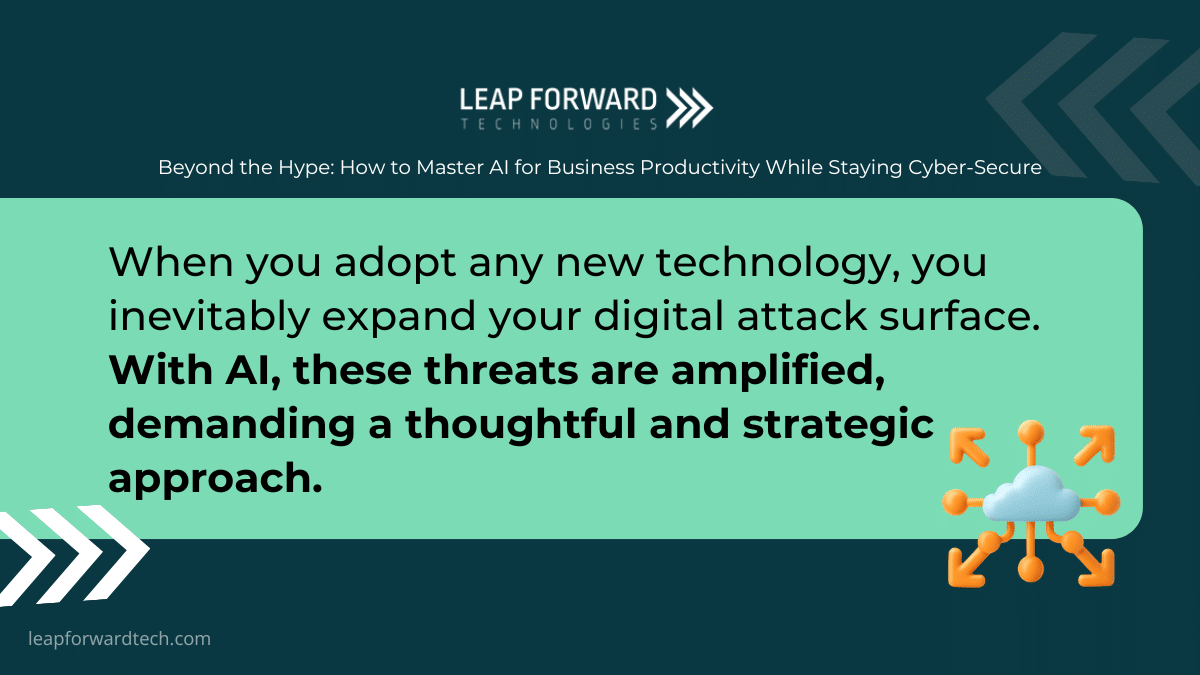
When you adopt any new technology, you inevitably expand your digital attack surface. With AI, these threats are amplified, demanding a thoughtful and strategic approach.

The Danger of Data Leakage
Every AI model thrives on data. When you feed sensitive customer data, financial information, or proprietary work products into a third-party AI model, you create a potential security breach. Without a clear contract, that AI company could store your data, use it for training their public models, or even suffer a leak that compromises your organization. This is a clear, existential threat to your competitive edge.
The Uncontrolled Rise of Shadow AI
Your employees are already using AI. They’re signing up for free online chatbots and generative platforms to make their work easier. This “shadow AI” usage operates outside of your compliance and security protocols, creating an immense vulnerability. Every unvetted platform is a potential open back door to your network.
Overreliance and Automation Bias
Technology is a tool, not an oracle. A major risk is the human tendency to trust AI-generated content implicitly. If an employee relies on inaccurate or ‘hallucinated’ AI output without their own due diligence, it leads to poor decision-making a failure that is both operational and strategic.
The Plan: Securing AI for Business Productivity in West Central Minnesota
The path to safely leveraging AI is about implementing clear, common-sense guardrails. You need to be the confident Guide who provides the structure for your team’s innovative Hero’s Journey.

1. Establish a Non-Negotiable AI Usage Policy
Before any new tool is deployed, you must set clear boundaries. An effective AI policy is not a limitation it’s a foundation for secure innovation. Define:
- Approved Tools and Vendors: Only permit the use of pre-vetted, enterprise-grade AI platforms.
- Prohibited Data Types: Clearly outline which data (PII, financial, IP) can never be uploaded to public or third-party models.
- Acceptable Use Cases: Specify how and when AI tools can be utilized for core business tasks.
2. Prioritize Enterprise-Grade AI Platforms
To mitigate the risk of data leakage prevention, you must demand more from your technology partners. Select platforms that offer:
- Data Residency Controls: Guaranteeing where your data is stored.
- Data Isolation: Ensuring your data is not used to train the general public model.
- Robust Compliance: Meeting standards like HIPAA, GDPR, or SOC 2.
- End-to-End Encryption: Protecting your data both at rest and in transit.
3. Implement Role-Based Access Controls (RBAC)
Not everyone needs access to all information. Adopting RBAC ensures that AI tools and the employees using them can only access the specific, segmented data necessary to perform their role. This minimizes the blast radius of a potential breach.
4. Monitor AI Usage and Train Your People
Ironically, the human element remains the weakest link in any defense chain. The most advanced security tools can be undone by a single click. Regular, mandatory training is non-negotiable. Your team needs to understand the dangers of AI-generated phishing attempts and the compliance risks of using unapproved tools. You must also monitor usage to spot unusual activity or risky data transfers before they become a crisis.
The Success: AI With Guardrails
When executed correctly, your AI strategy will transform your organization. You will move from uncertainty to a position of confidence, gaining a clear competitive edge with a team that is more productive, more secure, and less prone to human error. You will have a clear, documented path to success, avoiding the failure of a devastating data breach.
Don’t let the fear of AI cybersecurity risks paralyze your business or force you to settle for the operational drag of outdated manual processes. Leap Forward Tech provides the expert guidance, practical toolkits, and proactive management your business needs to harness the power of secure AI for business productivity in West Central and Southwest Minnesota.
Ready to implement a secure, scalable AI strategy that protects your future while boosting your bottom line?
Contact Leap Forward Tech today to schedule a strategic AI security assessment.